As we move into the winter season, both human and animal allergies start to resolve until the next seasonal challenge begins. Some animals are plagued with year-round issues. Others only have seasonal challenges. There is no textbook consistency when it comes to allergies. Some animal medical conditions always behave in a certain way. This is not the case for allergies. Let me share some opinions I have about allergies that I feel must be considered to find some success in treatment and therapy.
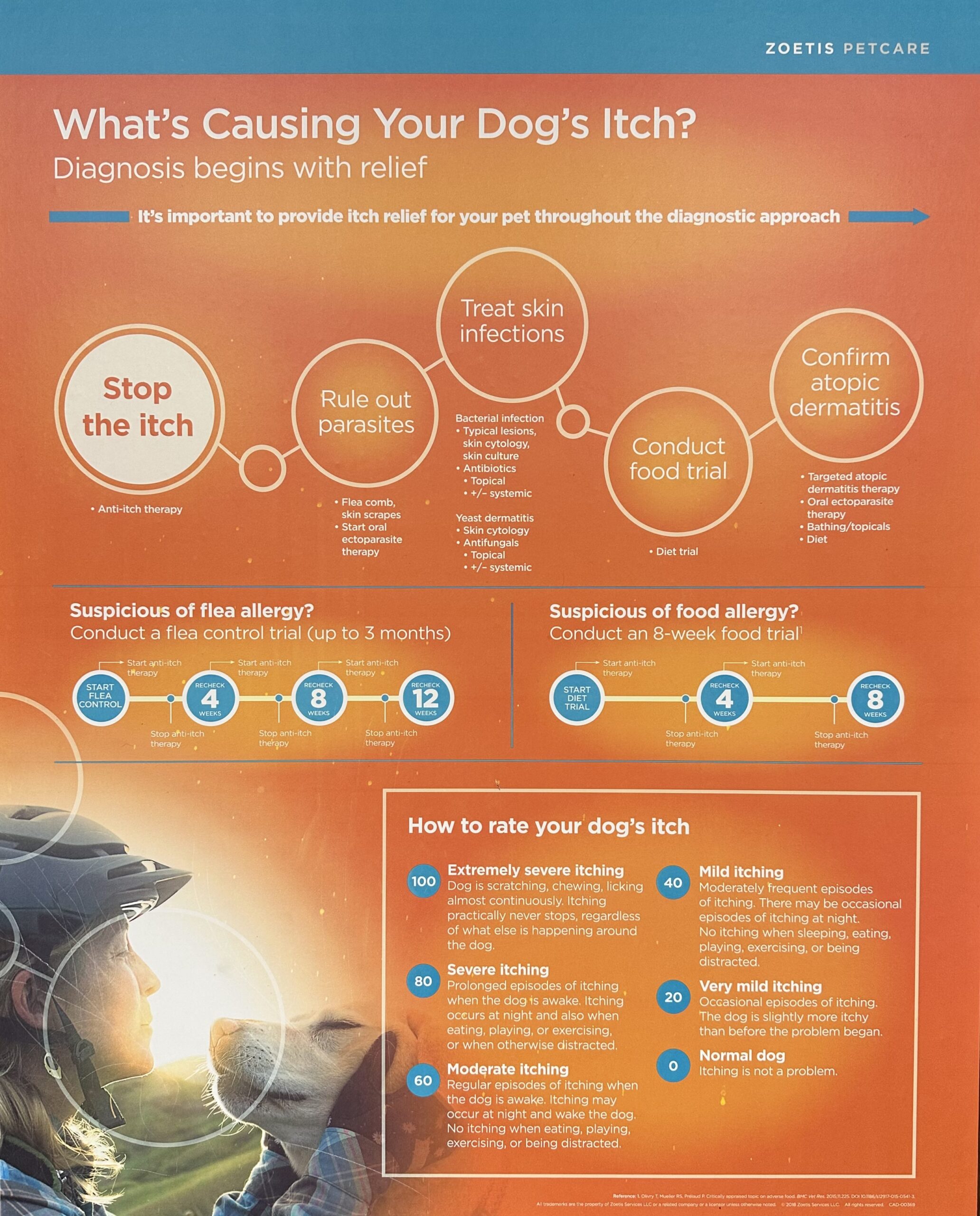
- Always have your pets on flea and tick prevention year-round. If your dog or cat are Itching, get them on good flea control. Talk with your veterinarian since we have an injectable Flea and tick, Bravecto Quantum, for dogs that lasts for an entire year. Don’t tell me you don’t have fleas. A flea is impossible to find in small numbers. One flea bites a dog or cat 50-60 times a day. That will make them itch. I have sent people home with good flea/tick prevention and that solved the problem. One dog may have an allergy to flea bites and that dog itches and the other pets in the home show no reactions. This is why all dogs and cats should be on good flea/tick control.
- Skin infections must be treated along with allergies, or you will struggle to get resolution of the itching. That includes bacterial or fungal infections. If your dog smells like corn chips, they probably have yeast on their skin and need medicated shampoos to get rid of that. Dogs that lick and chew at themselves create a perfect environment for yeast to thrive and create more itching. Antibiotics may be needed if the skin is broken or has scabs/pustules present.
- Realize that your dog will always have allergies. This is not something that can be treated and will not return. Many dogs start with allergies sometime between 2-5 years of age. It starts out minor with some feet licking or ear itching. With each passing year the symptoms intensify. Eventually the symptoms will be so intense that you cannot sleep. You get exhausted watching your dog scratch or chew all the time. Google tells you to try antihistamines or probiotics but nothing works.
- Itching of ears and eyes can be only on one side. I cannot explain this. I just know that we see it all the time. Every year that same ear or eye flares, or it will switch to the opposite one. No consistency as I mentioned in my opening statement.
- Year-round allergies can indicate food sensitivity. I like to do food trials in the winter months since we reduce the allergic response of the environment. If we offer hypoallergenic diets during an 8–12-week period and the pet improves, we can then hope as we approach warmer seasons the allergy response will be less. Talk to your veterinarian about food trials if you think this could be part of your pet’s issues.
- It is possible to have an intense allergy reaction one year and nothing the next year. All I can think of is that in a dry summer different plants pollinate than in a wet summer. Summer 2025 we had more rain than usual so possibly there are different plants pollinating different years. Your pet may be more reactive to plants that pollinate one year more than another. Again, this is my opinion.
- Our current allergy products are successful if they reduce the itch by 50%. The companies that make these products like apoquel and cytopoint do not guarantee 100% success in stopping the itch. Do some dogs respond better than others when using these products? Most definitely. Cytopoint can be given as often as once a month, but many dogs get 8 weeks of improvement. If your dog is itching and it has been a month, go get another cytopoint injection. If you are using apoquel daily and your dog has an intense allergy flare, increase the apoquel to one tablet every 12 hours for up to 2 weeks. Drop back down to daily dosage after the two weeks to reduce the immunosuppression seen at higher levels for longer periods of time.
- Most dogs will have a season where nothing seems to work sometime in their life. If you did everything right, medicated shampoos, flea and tick prevention, allergy medications, antibiotics, special foods etc., you may still have an itchy dog.
The dog’s allergies will intensify with each passing year. That can create challenges when it comes to treatment. Years ago, before Cytopoint and Apoquel, many dogs were managed on steroid injections or medications. It did suppress the allergic response, but the dogs had many other undesirable side effects. Dogs drank way too much water and therefore urinated inappropriately while on the medication. The dogs had a huge appetite and gained weight on the steroids. Long term we saw hormonal issues especially with the adrenal gland. We were excited for the new options to treat allergies but on rare occasions we must go back to steroids to control some dog’s allergy responses. Speak with your veterinarian if you feel the quality of life for your pet warrants steroid usage.
- Purebred dogs and mixed breed dogs all have potential to have allergies. Years ago, it was thought that a mixed breed dog had less health issues than purebred dogs. I think we all can say that is an old wife’s tale. With the introduction of “doodles” mixes we see as many allergies in them as we do the purebred pets. We see one in a litter have issues and others in the litter are completely normal . No different than children in a family. Lots of variety there as well.
- Final observation is that frost is our friend when it comes to allergies for many pets. I now tell people Thanksgiving is when we can expect to see a solid frost in Iowa. That season has just come and gone. Hopefully if you have been battling allergies in your pet, relief is coming.
Opinions are not based on scientific evidence. These are just observations after years of working with pet owners and their allergic pets.
Cats are a whole different ball game. Fortunately, cat allergy issues are less common. If you see seasonal itching in a cat, talk with your veterinarian. My experience is ear itching during certain seasons of the year with some cats. They can be strictly indoors and still have ear itching. A topical medication placed in the ears will help reduce the symptoms until a sold frost appears.
As we enter into the final month of 2025, I want to thank you for reading my blogs. I hope your Christmas Season is filled with family and friends. I hope your pet’s allergies are controlled. I wish for good health and joy in the New Year. See you next year.